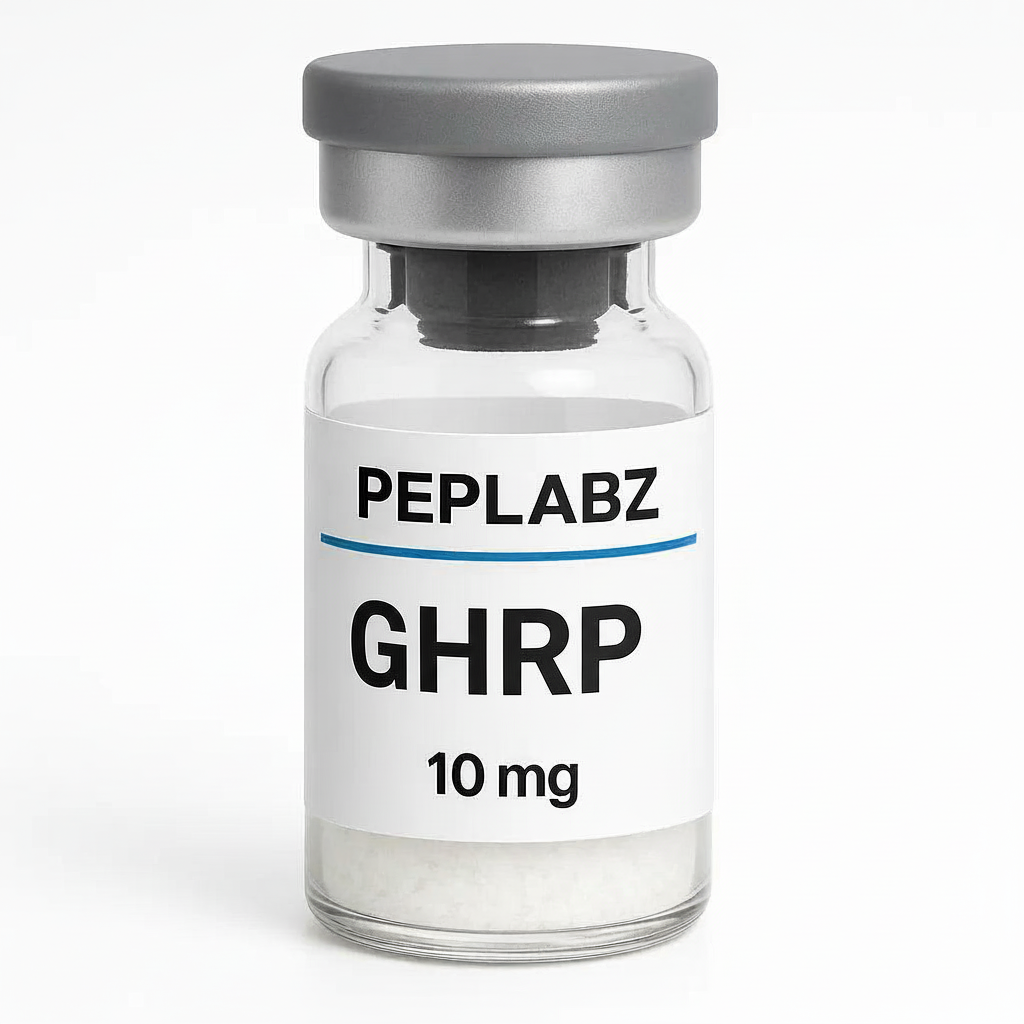
 GHRP
GHRP 
GHRP-2: Mechanisms, Research Applications, and Scientific Significance
In the expansive field of endocrine research, growth hormone-releasing peptides (GHRPs) represent a crucial category of secretagogues. Among these, GHRP-2 (Growth Hormone-Releasing Peptide-2) has emerged as a particularly potent and selective compound of interest. As researchers continue to investigate the nuances of growth hormone (GH) secretion and metabolic regulation, GHRP-2 serves as a foundational tool for laboratory studies.
At Peplabz, we recognize that the success of your laboratory research depends on the reliability and purity of the peptides you utilize. This guide explores the scientific profile of GHRP-2, its mechanism of action, and best practices for its application in a research environment.
What is GHRP-2?
GHRP-2, also known as Pralmorelin, is a synthetic, hexapeptide growth hormone secretagogue. Unlike growth hormone-releasing hormone (GHRH), which acts through its own distinct receptor, GHRP-2 functions primarily as an agonist of the ghrelin receptor (also known as the growth hormone secretagogue receptor, or GHSR-1a).
Structurally, GHRP-2 is designed for high potency and efficacy. Its primary biological function in a research setting is to stimulate the anterior pituitary gland to release growth hormone. Its high affinity for the ghrelin receptor makes it a valuable subject for studies concerning appetite regulation, metabolic signaling, and the complex feedback loops that govern the endocrine system.
The Mechanism of Action
The mechanism of GHRP-2 involves a sophisticated interplay within the hypothalamus and the pituitary gland. By binding to the ghrelin receptor, GHRP-2 triggers a signal transduction pathway that increases the pulsatile release of growth hormone.
1. Selective GH Secretion
Research highlights that GHRP-2 is one of the most effective GH secretagogues currently studied in terms of the magnitude of the GH pulse it induces. Scientists investigate this peptide to understand how pulsatile secretion differs from sustained, static hormonal presence.
2. Receptor Specificity
While it mimics the action of ghrelin, GHRP-2 is specifically valued for its potent ability to stimulate GH secretion. Researchers use this specificity to isolate and study the ghrelin receptor’s role in various physiological models without the broader, often more complex systemic effects of native ghrelin.
Key Research Applications
The scientific study of GHRP-2 spans several critical areas of inquiry:
- Endocrine Function Mapping: Scientists use GHRP-2 to assess pituitary gland sensitivity and responsiveness in various research models.
- Metabolic Signaling: Because the ghrelin receptor is involved in appetite and energy balance, GHRP-2 is a subject of study in metabolic research, particularly regarding how hormonal signaling influences energy homeostasis.
- Cellular Repair and Growth: Investigations into GHRP-2 often examine the downstream effects of increased growth hormone levels, including potential influences on protein synthesis and cellular regeneration pathways.
- Satiety Pathways: Given its interaction with ghrelin receptors, researchers study how the compound modulates pathways related to food intake and metabolic adaptation.
Ensuring Research Integrity: Purity and Quality
The validity of any study involving peptide secretagogues is entirely dependent on the quality of the materials used. Contaminants, even at trace levels, can interfere with receptor binding, leading to inconsistent data and irreproducible results.
At Peplabz, we maintain rigorous standards to ensure the integrity of your research:
- High-Purity Synthesis: Our GHRP-2 is synthesized to meet high-level purity benchmarks, ensuring that each vial contains the precise compound intended for your laboratory trials.
- Sterile Packaging: We utilize medical-style, sterile glass vials to protect the peptide from degradation and contamination, ensuring it arrives ready for use in a controlled laboratory environment.
- Consistency for Reproducibility: We understand that reproducible data is the foundation of scientific advancement, and we prioritize consistency in every formulation we provide.
Laboratory Protocols: Storage and Handling
Because GHRP-2 is a synthetic peptide, its pharmacological activity is sensitive to environmental conditions. To ensure the compound remains effective throughout your research timeline, strict laboratory protocols should be followed:
- Environmental Control: Lyophilized (freeze-dried) GHRP-2 should be stored in a controlled, sub-zero environment—typically at or below -20°C—to maintain structural stability.
- Reconstitution Standards: When preparing the peptide for your experiments, use only laboratory-grade bacteriostatic or sterile water. Avoid vigorous agitation or vortexing, as this can denature the sensitive peptide chain; gentle, rhythmic swirling is the recommended method.
- Protection from Light: GHRP-2 is sensitive to UV light, which can cause photo-oxidation and subsequent degradation of the peptide. Ensure that vials are kept in opaque, light-resistant storage containers at all times.
Advancing Scientific Inquiry with Peplabz
As investigation into GH secretagogues and the ghrelin receptor continues to evolve, GHRP-2 remains a focal point for researchers exploring the complexities of hormonal regulation. Whether your laboratory is currently investigating metabolic signaling, protein synthesis, or the broader implications of growth hormone dynamics, access to a reliable, consistent source for your materials is a critical component of your methodology.
Peplabz is committed to supporting the scientific community by providing premium-grade peptides and the technical transparency required for high-stakes research. We invite you to explore our current catalog to find our research-grade GHRP-2 and discover how we can help you achieve the precision and consistency your laboratory projects demand.